Equity Group net profit profit surges 32pc to Sh45.5bn in 6 months
This story has significance for readers across Kenya and beyond.
Equity Group Holdings Plc has announced a 32 percent increase in net profit to Sh45.5 billion from Sh34.6 billion in the first half of the current financial year. This Equity Group net profit came in as a reflection of improved balance sheet quality and growth, rising contributions from its regional subsidiaries and increased non-funded income contribution.
Net interest income continued to strengthen, rising 17 percent to Sh69.3 billion from Sh59.3 billion, reflecting the depth of the Group’s lending franchise and disciplined balance sheet management. Total income grew 25 percent to Sh124.9 billion, up from Sh100.2 billion, driven by a sharp rise in non-funded income, which expanded 36 percent to Sh55.6 billion from Sh40.9 billion. Non-funded income now contributes 44.5 percent of the Group’s total income, up from 40.8 percent in the first half of 2025, underscoring Equity’s multi-line business, geographic diversification and revenue quality mix
The balance sheet also continued its upward trajectory, expanding 20 percent to Sh2.16 trillion. This growth was anchored by a 21 percent rise in customer deposits to Sh1.59 trillion and a 19 percent increase in net loans to Sh981 billion, demonstrating sustained customer confidence and strong credit demand across the markets where Equity operates. Shareholders’ funds grew 27 percent to Sh350 billion, reinforcing the Group’s capital strength.
Equity now serves 23.3 million customers through various digital platforms, including Equity Online for Business and Individuals, Eazzy FX, the Equity Mobile App, *247#, and Equitel, complemented by 410 branches, 886 ATMs, 92,572 agency outlets, and 1.4 million merchants. Together, these channels reflect one of the region’s most extensive and diversified financial services ecosystems.
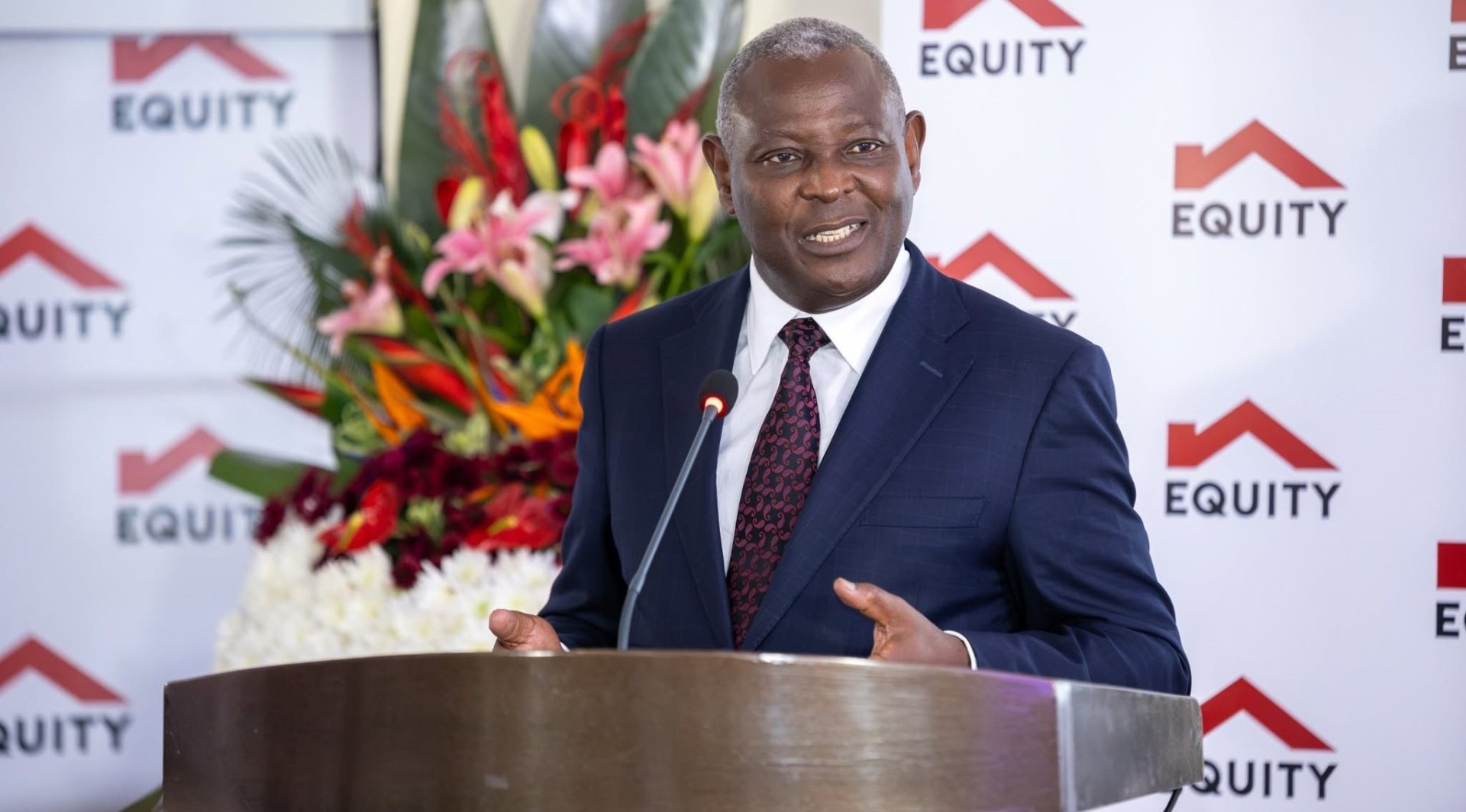
“The Group’s performance is unfolding against a backdrop of resilient regional economic growth. Kenya is projected to expand by 4.5 percent to 5 percent, the Democratic Republic of Congo by 5.6 percent, Tanzania by 5.9 percent, Uganda by 6.4 percent, Rwanda by 6.8 percent, and South Sudan by 20 percent. These growth rates are supported by firm commodity prices and policy reforms and are expected to sustain, making the region where we operate one of the fastest growing regions in the world,” said Dr James Mwangi, the Group Managing Director and chief executive officer.
Equity’s half-year 2026 performance is the outcome of a multiyear transformation agenda focused on resilience, diversification, and technology enablement. The Group has repositioned its operating model, strengthened its regional presence, and invested heavily in digital and AI-enabled capabilities to build an institution equipped for the future.”
Operational efficiency continued to improve, with the cost-to-income ratio improving to 48.6 percent from 51.7 percent, driven by productivity gains, shared services, and a decisive customer shift toward digital channels. Return on Assets stood at 4.5 percent, while Return on Equity reached 26.5 percent, demonstrating strong asset productivity and disciplined capital allocation.
“Our H1 2026 performance reflects the success of our deliberate transformation into a diversified, regional, technology-enabled financial services Group. We are building a future ready institution; scalable, secure, and impact led, anchored in digital capabilities, staff upskilling, and a culture of disciplined execution,” said Dr Mwangi.
‘As we progress towards our Africa Recovery and Resilience Plan (ARRP) 2030 ambitions, we are evolving beyond traditional banking into an integrated tech enabled financial institution that mobilizes capital, connects ecosystems, and accelerates inclusive, sustainable prosperity across Africa.”
Equity’s technology-enabled transformation is now firmly embedded across the Group. Customer behavior continues to shift decisively toward digital channels, with 98.3 percent of all transactions occurring outside branches and 89.7 percent processed through digital platforms, demonstrating that customers are actively choosing the convenience and reliability of Equity’s digital ecosystem.
Digital adoption continues to accelerate across the Group, with 98.3 percent of all transactions now occurring outside branches and 89.7 percent processed through digital platforms. These trends highlight customers’ growing preference for Equity’s digital ecosystem and the reliability of its technology infrastructure.
During the period under review, non performing loans coverage improved to 70 percent, up from 68 percent, while loan loss provisions fell 6 percent year-on-year. The loan book recorded a notable improvement in non-performing loans, declining from 13.7 percent to 9.5 percent, driven by disciplined underwriting, improved analytics, and a diversified portfolio. Cost of risk improved to 1.4 percent down from 1.7 percent.
Equity Bank Kenya’s recovery momentum continued, posting a 32 percent increase in net profit to Sh25.7 billion with a 13 percent growth in assets underpinned by a 24 percent deposits growth and 8 percent loans growth. The bank recorded a return on average assets and a return on average equity of 4.8 percent and 34.7 percent respectively, all while maintaining its MSME leadership by disbursing 36 percent of the Sh101 billion MSME loans issued in Kenya between January and March 2026.
Regional subsidiaries delivered strong and accelerating performance, now contributing 42 percent and 47 percent of the Group’s banking profitability and revenue respectively, 51 percent of Group deposits, 54 percent of Group loans and 52 percent of Group banking assets, a testament to the success of the Group’s pan-African expansion strategy. Equity BCDC in the Democratic Republic of Congo achieved a 30 percent rise in net profit to Sh11.8 billion. Equity Rwanda grew net profit by 12 percent to Sh2.9 billion, and Equity Tanzania delivered exceptional performance with 82 percent growth to Sh2.0 billion.
Reporting originally appeared via Bizna Kenya. Read the full source for additional context.