Fact check: How do I spot propaganda?
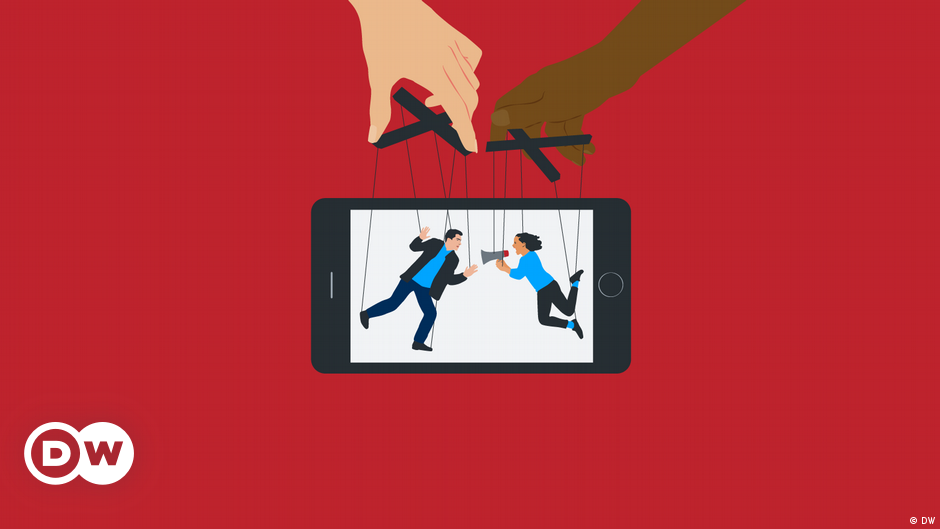
The 2026 US-Iran war was not just fought on the battlefield, but also across social media.
AI-generated animations inspired by "The Lego Movie" showcased Iran's military power, while another animated video depicted a supersized version of US Vice President JD Vance rampaging through Tehran like Godzilla.
Accounts sharing this kind of content have amassed millions of views and offer a powerful example of propaganda in the age of artificial intelligence.
They also illustrate how propaganda, while far from a new phenomenon, continues to evolve alongside technology.
So, what is propaganda? And how can you spot it?
DW Fact check offers tips to help you navigate today's information landscape.
Defining propaganda
Propaganda is often described as the deliberate use of information by governments, politicians and other actors to shape people’s beliefs, attitudes or behavior.
It relies on the selective presentation of information, emphasizing certain facts while omitting or misrepresenting others.
Propaganda is not only deployed by authoritarian countries like Russia, China and North Korea; it can be found all over the world.
A key difference between systems is that propaganda in authoritarian states is often heavily centralized and tightly controlled.
In democratic societies, propaganda is often more pluralistic, produced by a wider range of actors.
Moreover, freely accessing alternative media outlets and information is far more straightforward in democracies.
What is the purpose of propaganda?
Talking to DW, Piers Robinson, a political scientist with the Organisation for Propaganda Studies, said propaganda can persuade someone to act or behave in a particular way.
He cited the example of how US politicians worked to convince the public to support the 2003 invasion of Iraq.
"In that case, famously, they exaggerated intelligence about weapons of mass destruction to make Iraq appear a bigger threat than it really was," said Robinson.
No weapons of mass destruction were ever found in the country. Images presented by the CIA purporting to prove their existence constituted misinformation deployed for propaganda purposes.
The Iraq War demonstrates another key aim of propaganda: vilifying political opponents, rival countries, or cultures or values seen as undesirable or threatening.
US President Donald Trumpis a case in point.
Researcherswho have studied his political rhetoric point to his frequent use of name-calling as a technique for discrediting political opponents and to his use of exaggerated claims to portray undocumented immigrants disparagingly.
Propaganda is not always negative. It's also designed to cast politicians and governments in a positive light, said Pavel Koshkin, a senior research fellow at the Institute for US and Canadian Studies of the Russian Academy of Sciences.
In Russia, Koshkin said, state-sponsored propaganda is utilized to create a "democratic image of Russia."
What role do media outlets play in spreading propaganda?
Media organizations can spread and amplify propaganda messages either knowingly or by mistake, Christian Mihr of Reporters Without Borders (RSF) told DW.
Russian state-funded broadcaster RT, for instance, is often accused of serving as a Kremlin mouthpiece. Its coverage largely reflects the Russian government's official position.
Ideally, media organizations play the opposite role: as watchdogs to sniff out and debunk propaganda.
Indeed, media researchers say this is one of the most important tasks expected of journalists.
RSF's Mihr said journalists are in an ideal position to help contextualize political propaganda by asking lawmakers tough questions and interviewing independent experts.
And what about AI-fueled propaganda?
Artificial intelligence is dramatically changing the way propaganda is created and distributed.
While producing propaganda once required hours or days of work, AI tools can now generate images, videos and audios in minutes.
This allows governments and other actors to adapt messages quickly and tailor them to different audiences, platforms and languages.
That's where the term "slopaganda" comes in. It combines propaganda and slop, a term often used for low-quality, AI-generated material.
Consider the AI-generated images mentioned above that circulated during the 2026 US-Iran war.
Their widespread use has led some observers to describe the conflict as a "slopaganda war", highlighting the emergence of a new form of online information warfare.
So, with all this in mind, how can you tell whether you’re looking at propaganda?
Tips to detect propaganda
Although propaganda is often subtle, there are, nevertheless, ways of identifying it.
One of the most effective ways is to look closely at where the information comes from.
Did a government official or agency publish the message? Does it come from a state-funded media outlet? Or from an account linked to one?
Take a moment to learn more about the source.
Who runs the source? Is there a disclosure included somewhere? Can I find information about how it is funded? Is its purpose clear?
The more information you can find out, the better you will be able to evaluate a source. And don’t forget: a lack of transparency is often a red flag.
Once you've analyzed where the information comes from, it's time to look at the content itself.
Be wary of information that provokes strong emotions, both positive and negative. Propaganda and "slopaganda” are often designed to trigger emotional reactions rather than encourage critical thinking.
Take a moment to pause if a post makes you feel angry, fearful or outraged. Or if it appeals strongly to your personal, religious, ethnic or national identity.
In addition, look carefully at what the post actually says. Reading about the topic, consulting independent sources and comparing different perspectives can help you assess a message critically.
Ask yourself the following questions:
- Is the post presenting complex issues in simple, black-or-white terms?
- Is it claiming that only one viewpoint is acceptable?
- Is it demonizing groups or opponents?
- Is it using facts selectively and leaving out important context?
- Is it using statistics in a misleading way?
Finally, be skeptical of volume. As we saw above, "slopaganda" relies on spreading large amounts of low-quality, emotionally charged content.
One of its aims is to create the impression of consensus: the more often people see a message, the more likely they may be to perceive it as widely accepted.
So if you repeatedly see a message or come across the same claim, take a step back and investigate further.
This article was first published in 2022 and has been revised to incorporate new developments and trends. The experts featured were interviewed for the original article, and their insights continue to provide valuable context for the issues discussed.
This article is part of a DW Fact check series on digital literacy. Other articles include:
- How do I spot manipulated images?
- How do I spot AI-generated images?
- How do I spot audio deepfakes?
- How do I spot state-sponsored propaganda?
- How do I spot fake social media accounts, bots and trolls?
And here you can read more about how DW fact-checks fake news.
Edited by Josh Axelrod.
Reporting originally appeared via DW News. Read the full source for additional context.