How do teenagers keep accessing guns in Southeast Asia?
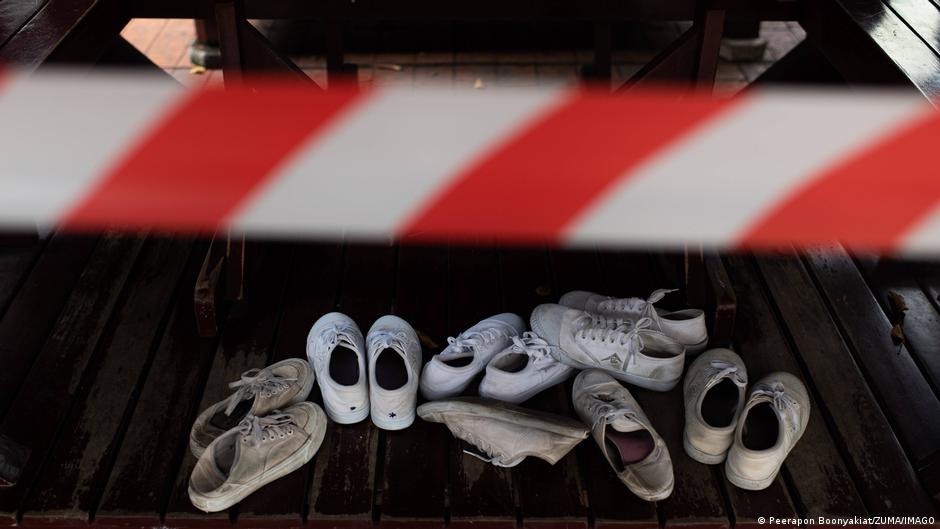
On August 7, a 14-year-old Thai student killed his grandparents before taking his grandfather's handgun to his school outside Bangkok and killing five teachers and staff members and a 12-year-old student. The attacker then turned the weapon on himself.
Police said the teenager fired at least 26 rounds during the attack, Thailand's deadliest mass killing in almost four years.
This week, another school shooting occurred in the southern Philippine city of Zamboanga, when a ninth-grade student killed another pupil and later died by suicide. Police said one of the weapons belonged to his father, a customs police official.
The attacks raise questions not only about Thailand and the Philippines' unusually large civilian gun stockpile, but also about how legally owned firearms are stored, transferred and allowed to fall into other people's hands across Southeast Asia.
Thailand tops list of gun ownership
The Small Arms Survey estimated in 2017 that Thai civilians possessed around 10.3 million firearms, equivalent to roughly 15 guns for every 100 people, by far the highest rate in Southeast Asia. Just over 6 million were registered, leaving more than 4 million unregistered.
The Philippines rivals Thailand, with several million firearms believed to be in civilian hands and a comparatively high rate of firearm killings, although fewer per capita than in Thailand. Malaysia has fewer than one civilian gun for every 100 people, while Indonesia's rate is lower still.
Thailand's estimated firearm death rate of 3.49 per 100,000 people is one of the highest in Asia, according to the World Population Review.
Thailand has experienced a succession of high-profile attacks in recent years, including a school shooting in southern Thailand this February.
In 2020, nearly 30 people were killed by a gunman at a shopping mall in the northern city of Nakhon Ratchasima. In 2022, a massacre at a childcare center left 37 people dead. A shooting at a Bangkok shopping mall in 2023 led to calls for tighter gun laws.
At first glance, Thailand's laws appear restrictive. Separate authorisation is required to purchase, possess and carry a firearm, and there are several layers of registration for legal firearms.
Yet possession licences remain valid for life, applicants are not subjected to mental-health screening, and licence holders are not periodically reassessed.
For years, government "welfare gun" programs have allowed police officers and other officials to obtain discounted firearms. Critics say weak restrictions on their eventual resale have helped create a vast secondary market.
"If Thais want a gun, they can easily acquire an illegal one on the black market," Piyaporn Tunneekul, a criminologist and associate professor at Nakhon Pathom Rajabhat University, told DW.
Thailand responds to shootings
Following this month's school shooting, Thai Prime Minister Anutin Charnvirakul suspended new firearm purchase permits and ordered existing licences to be reviewed.
The government is also considering limiting licence validity, tightening health checks, increasing penalties and introducing an amnesty for unregistered weapons.
But Thailand has been here before. Anutin was interior minister when previous shootings led to emergency responses that were later toned down.
"Southeast Asia's firearms problem is not simply a problem of weak gun laws. In many countries, the laws are already relatively comprehensive. The deeper problem is the gap between regulation on paper and the political economy through which firearms actually circulate," Raihan Yusoph, a researcher of firearms and violence at the Mindanao State University–Marawi City in the Philippines, told DW.
Southeast Asian governments themselves have acknowledged the cross-border dimension, and the Association of Southeast Asian Nations (ASEAN) adopted a declaration on combating arms smuggling in 2023.
"Large existing stocks are another problem," Yusoph said. "Once millions of firearms are already in circulation, registration laws alone cannot make them disappear," he added.
Who is responsible when a gun changes hands?
The two recent Philippine school shootings illustrate another weakness.
In Zamboanga this week, the firearm used by the teenage attacker belonged to his father. In Tacloban in June, two teenagers killed three students and wounded about 20 others. One attacker used a Glock issued to his aunt, a police officer, while the other used a revolver registered to a private security company.
The Tacloban attack triggered a heated debate over juvenile criminal responsibility, and Philippine politicians revived proposals to lower the age at which children can be held criminally responsible.
"That is a distraction from the more fundamental question of firearm access," Yusoph said, adding that the Philippine government itself acknowledged that there is a legal gap concerning the criminal responsibility of firearm owners whose weapons are used by others.
There are now calls in Southeast Asia for more systemic legislation rather than knee-jerk reactions.
This includes making gun owners more accountable throughout the lifetime of a weapon, with tougher storage requirements, regular licence renewals, and penalties where negligence allows children or other unauthorised people to gain access.
It also means tracking weapons more closely once they leave police or military inventories and improving regional intelligence sharing against illicit trafficking. National crackdowns have limited impact if guns can move between legal and illegal markets or across porous borders.
Guns a 'symbol of power'
However, some analysts say a problem that cannot be tackled by legislation is the social status attached to firearms.
"In the mindset of Thai people, firearms are often viewed as a symbol of power," Tunneekul said.
A firearm can offer its owner a sense of personal protection, but it can also project status and the ability to intimidate others, which "continually drives up the demand for weapons," she said.
"In the past, firearm violence in Thailand was largely limited to personal disputes or street crime," Tunneekul added.
"However, as the world has evolved, social and economic dynamics have shifted. People increasingly view others as enemies over minor grievances, accompanied by declining patience and sound judgment when resolving conflicts. This lack of restraint leads to unthinkable actions.”
Tougher legislation alone may struggle to solveThailand's problem. The challenge for governments is not just how to make guns more difficult to buy but how to make every person and institution that possesses one responsible for where that weapon ends up.
Edited by: Wesley Rahn
Reporting originally appeared via DW News. Read the full source for additional context.